Introduction
In many AOI and machine vision projects, customers first care about camera resolution.
This is understandable. A higher-resolution camera sounds like a direct way to see smaller defects.
But in real inspection systems, the camera is only one part of the imaging chain. If the lens cannot keep the image clear and stable across the full field, the final inspection result may still be unreliable.
This is especially true for AOI systems, PCB inspection, wafer inspection, display panel inspection, connector inspection, and precision component inspection.
For these applications, the center of the image is not the only area that matters. Small defects may appear anywhere in the field of view. If the image becomes soft near the edge, or if the distortion is not well controlled, the system may miss defects or produce unstable measurement results.
This is why flat-field machine vision lenses are important for precision inspection.
As a custom optical lens manufacturer, VY Optics provides flat-field machine vision lens solutions for AOI, precision inspection, industrial imaging, and customized optical systems.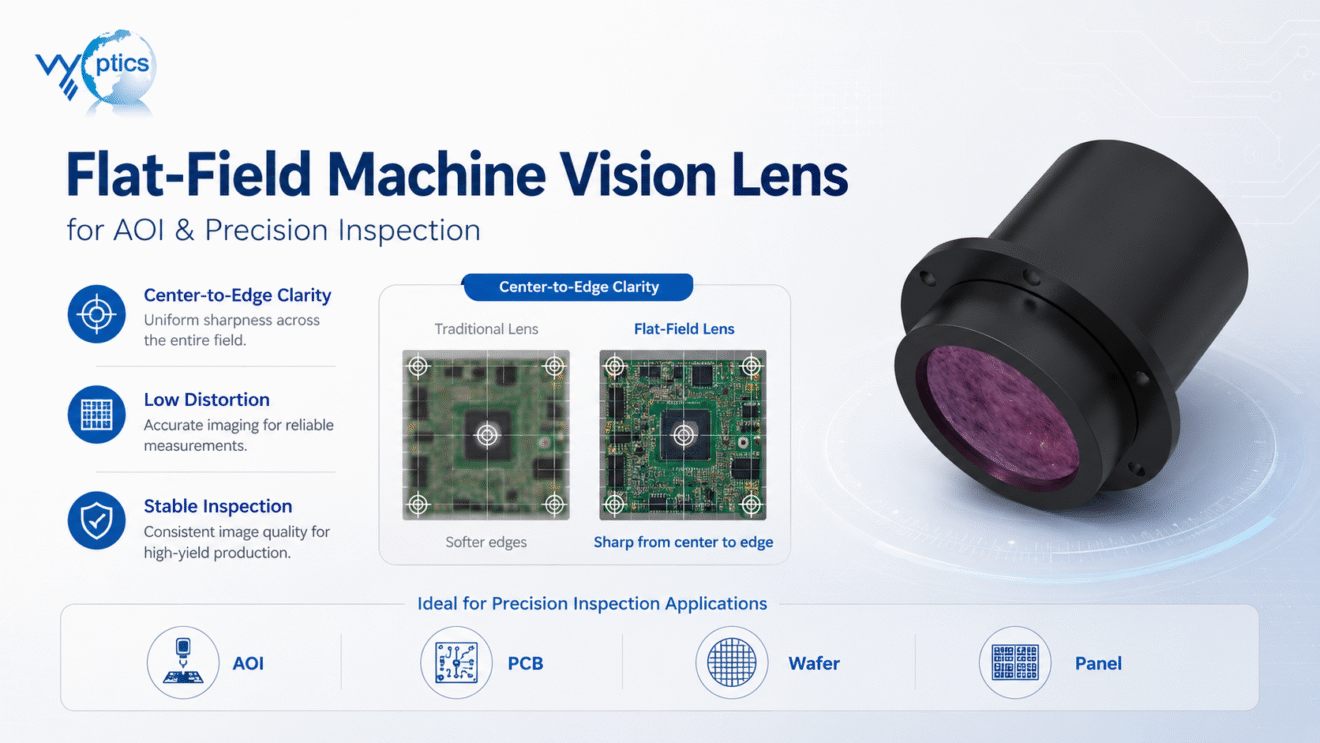
Flat-field machine vision lenses help AOI systems achieve more consistent center-to-edge image quality and stable inspection results.
Why AOI Needs Flat-Field Imaging
A common problem in AOI systems is that the image looks sharp in the center, but the edges are not clear enough.
At first, this may not look serious. But once the system starts working on real parts, the problem becomes more obvious.
For example, small scratches, particles, edge defects, or tiny structural features may be easier to recognize in the center, but harder to detect near the edge of the image.
For production-line inspection, this can lead to:
- missed defects
- false rejects
- unstable edge recognition
- inconsistent measurement results
- repeated software compensation
- longer debugging time
In some AOI and precision inspection projects, the inspected feature size can be very small. We have worked on flat-field imaging lens solutions where the system needed to observe features around 12 μm under the required optical configuration.
When the target feature is this small, center sharpness alone is not enough. The image quality must remain usable across the full field.
This is the real value of a flat-field lens.
What Is a Flat-Field Machine Vision Lens?
A flat-field machine vision lens is designed to reduce field curvature and improve image consistency from the center to the edge of the image.
In simple words, it helps the camera see a flatter image plane.
This does not mean every point in the image will be perfect under every condition. In real optical design, performance always depends on sensor size, wavelength, aperture, working distance, field of view, and mechanical structure.
But compared with a general imaging lens, a flat-field lens is more suitable for applications where full-field clarity is important.
For AOI and precision inspection, this usually matters more than making only the center area look very sharp.
Key Optical Requirements for AOI Lenses
When choosing or designing a lens for AOI, we usually look at more than one parameter.
A useful AOI lens should consider:
- field flatness
- center-to-edge resolution
- distortion control
- sensor size matching
- working distance
- aperture and depth of field
- mechanical stability
- focus locking structure
- illumination compatibility
For many customers, the real question is not simply:
“Is this a high-resolution lens?”
A better question is:
“Can this lens support stable inspection under my actual working conditions?”
That includes the camera, lighting, object size, inspection speed, installation space, and required defect size.
Why Low Distortion Also Matters
AOI is not only about seeing defects. Many systems also need to measure position, width, edge distance, hole size, or part alignment.
If the lens has obvious distortion, the image may be slightly stretched or compressed in different areas. Even if the software corrects part of it, large or unstable distortion can still affect the final result.
This becomes more important when the inspected features are small.
For example, when customers need to observe or judge features around 12 μm, small changes in image quality, edge softness, or distortion can affect the inspection result.
That is why low distortion and flat-field performance often need to be considered together.
Typical Applications
Flat-field machine vision lenses are useful in many industrial and scientific imaging applications.
Typical applications include:
- AOI equipment
- PCB inspection
- wafer and semiconductor inspection
- display panel inspection
- connector inspection
- electronic component inspection
- precision parts inspection
- surface defect detection
- automated production-line inspection
- scientific imaging platforms
For these applications, stable imaging is often more valuable than a beautiful image in only one area.
A lens used in real inspection should help the system maintain repeatable results.
Flat-Field Lens Manufacturer for AOI Applications
For customers looking for a flat-field lens manufacturer for AOI applications, VY Optics can support the project from optical design to manufacturing, lens assembly, alignment, and mechanical integration.
This is useful when a standard lens cannot meet the required field of view, working distance, sensor size, wavelength, or inspection accuracy.
In some projects, customers only need an optical component or lens group. In other projects, they need a complete lens module with mechanical structure and assembly support.
This is where optical design, optical manufacturing, precision assembly, and mechanical integration need to work together.
Our Flat-Field Machine Vision Lens Capability
VY Optics provides customized flat-field machine vision lens solutions for AOI and precision inspection applications.
The lens can be designed or adjusted according to different system requirements, including:
- visible wavelength range: 400–700 nm
- customized wavelength options such as 450–650 nm, 532 nm, 850 nm, and NIR
- area-scan cameras, line-scan cameras, and scientific cameras
- sensor formats such as 1/2”, 2/3”, 1”, 4/3”, or custom formats
- focal lengths such as 16 mm, 25 mm, 35 mm, 50 mm, 75 mm, or customized design
- aperture options from F/2.8 to F/8
- working distance from 100 mm to infinity, depending on configuration
- distortion ≤0.5%, with precision versions available down to ≤0.1%
- C-mount, F-mount, M42, M58, or custom flange interfaces
- manual focus, lockable focus, or fixed-focus structure
The main design goal is not only to make the image clear in the center.
It is to help the system maintain more consistent image quality across the full field, so that inspection results are more stable in real production conditions.
From Machine Vision Lens to Microscope Objective
Different inspection tasks require different optical solutions.
For AOI and machine vision, a flat-field lens may be used to observe small features across a relatively larger field of view. In some of our previous flat-field imaging projects, the system needed to observe features around 12 μm.
For higher-magnification applications, the optical requirement can be different. For example, microscope objective solutions may be used for observing features down to around 1 μm.
These two types of requirements should not be solved by the same lens structure.
AOI lenses usually care more about working distance, field of view, distortion, and full-field consistency. Microscope objectives usually need higher magnification, higher numerical aperture, and stricter assembly accuracy.
For customers, the best solution depends on the real inspection target.
When Should You Consider a Flat-Field Lens?
A flat-field lens may be a good choice if your system has one or more of these problems:
- the image center is clear, but the edges are soft
- small defects near the edge are missed
- measurement results change in different image areas
- the camera resolution is high, but the image is still not stable
- software correction needs too much compensation
- the system needs more consistent image quality for batch inspection
- the current lens cannot properly match a larger sensor
If your application only needs a small central inspection area, a standard lens may still be enough.
But if your system needs stable image quality across the whole field, especially for AOI and precision inspection, flat-field lens design becomes much more important.
Why Custom Design Is Sometimes Necessary
Standard lenses can solve many common imaging tasks.
But not every AOI system has standard requirements.
Sometimes the customer needs a special working distance.
>Sometimes the sensor size is larger than usual.
>Sometimes the inspection target is reflective.
>Sometimes the defect size is very small.
>Sometimes the lens also needs to fit into a limited mechanical space.
In these cases, a customized optical solution may be more practical.
At VY Optics, we support:
- optical lens design
- optical component manufacturing
- precision lens assembly
- lens alignment and adjustment
- mechanical structure design
- opto-mechanical integration
Our goal is not only to provide a lens, but to help customers get a stable imaging result in their real system.
Final Thoughts
For AOI and precision inspection, image quality is not only about camera resolution.
A good inspection lens should help the system see clearly, measure reliably, and run stably in real production conditions.
Flat-field machine vision lenses are especially useful when customers need center-to-edge image consistency, low distortion, and reliable detection of small features.
If your AOI system has problems such as soft edges, missed defects, false rejects, or unstable measurement results, the lens may be worth checking before changing the camera or software again.
Need a Custom Flat-Field Lens for Your AOI System?
We can review your optical requirements if you develop an AOI system, upgrade a machine vision platform or source custom lenses for precision inspection.
VY Optics assesses optical demands and delivers feasible lens solutions for custom flat-field machine vision lenses used in AOI, PCB, wafer, display panel, connector and precision component inspection.
Please feel free to contact us with your sensor size, field of view, working distance, wavelength, and inspection target.
We can help evaluate the optical design direction and discuss a suitable lens solution for your project.
Founded in 2010, VY Optics started from precision optical manufacturing and gradually expanded into optical design and assembly support.
Our team mainly works on custom optical components, lens centering, optical alignment, and optical assembly for industrial and scientific applications.
Our main products include microscope objectives, precision plano optics, laser focusing optics, 4F optical systems, OCT imaging optics, collimation systems, Offner spectrometer systems, Offner relay systems, and high-precision Offner relay optical assemblies.